HaptoFlow High-Fidelity Real-Time Vibrotactile Generation
via Flow Matching for Virtual Reality

Michikuni Eguchi1,2   Yuichi Hiroi2   Takefumi Hiraki1,2

1University of Tsukuba     2Metaverse Lab, Cluster, Inc.

ISMAR 2026IEEE International Symposium on Mixed and Augmented Reality

Code is coming soon.

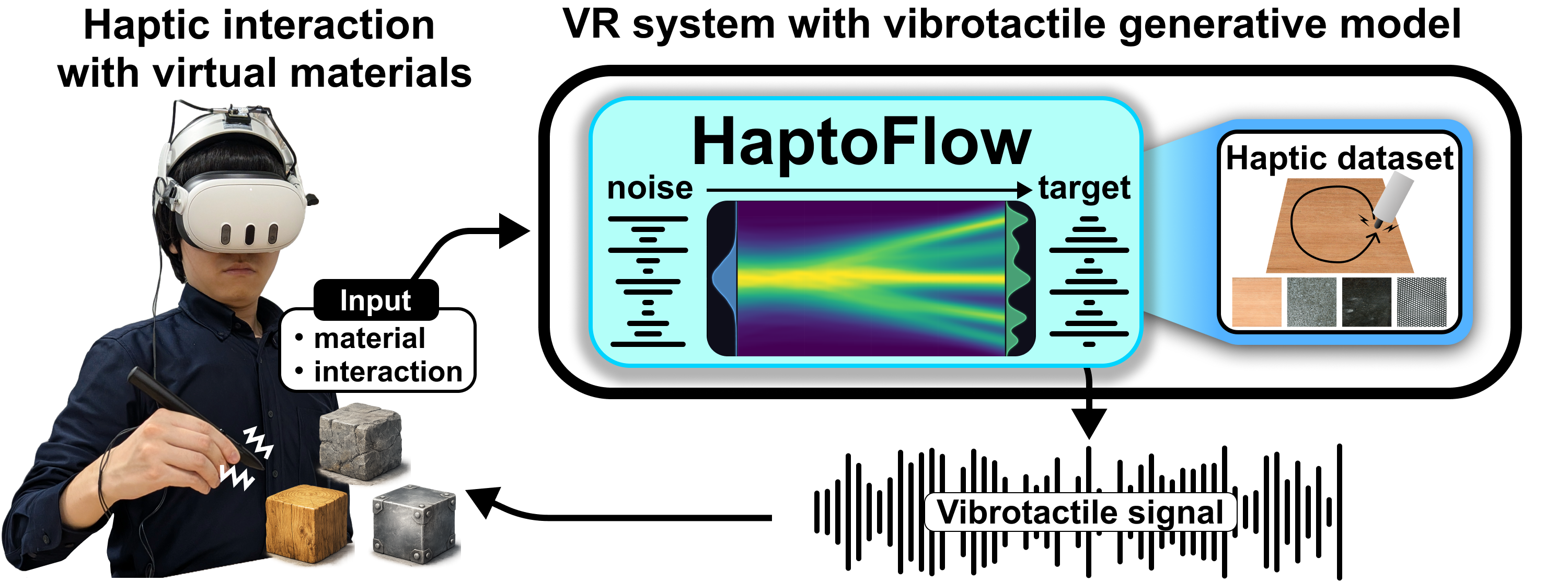
Overview of HaptoFlow and its integration into a VR system

Overview

HaptoFlow is a real-time vibrotactile generative model that produces realistic vibrotactile waveforms conditioned on material labels and interaction parameters (stroking velocity and applied force). Built on Flow Matching as its generative backbone, HaptoFlow outperforms existing models in both waveform reproduction accuracy and inference latency. This model enables scalable haptic design without manual authoring of individual waveforms.

Abstract

Haptic feedback is widely employed to enhance immersion in Virtual Reality (VR) environments. However, designing haptic stimuli that cover diverse interaction conditions remains a significant scalability challenge. Data-driven haptic generation has emerged as a promising approach, yet existing models face an inherent trade-off between waveform expressiveness and inference responsiveness, which becomes increasingly critical as training data grow in scale and diversity.

To address this challenge, we propose HaptoFlow, a vibrotactile generative model based on Flow Matching, designed for interactive real-time haptic rendering in VR. Flow Matching learns a continuous vector field that transforms a base distribution into the target data distribution, enabling efficient representation of complex haptic data distributions and thereby facilitating both high-quality generation and computational efficiency. We train HaptoFlow conditioned on material labels and interaction parameters (stroking velocity and applied force), and integrate it into a VR system.

Technical evaluation demonstrates that HaptoFlow outperforms all baseline methods in both waveform reproduction accuracy and inference latency. Furthermore, user studies confirm that the system latency falls well within the perceptual threshold of visual-haptic delay, and statistically significant improvements in perceived haptic quality are observed for a subset of materials. These findings establish a practical foundation for scalable, data-driven haptic content creation in VR, and provide latency benchmarks that inform the design of future real-time haptic rendering systems.

Method

Architecture of HaptoFlow
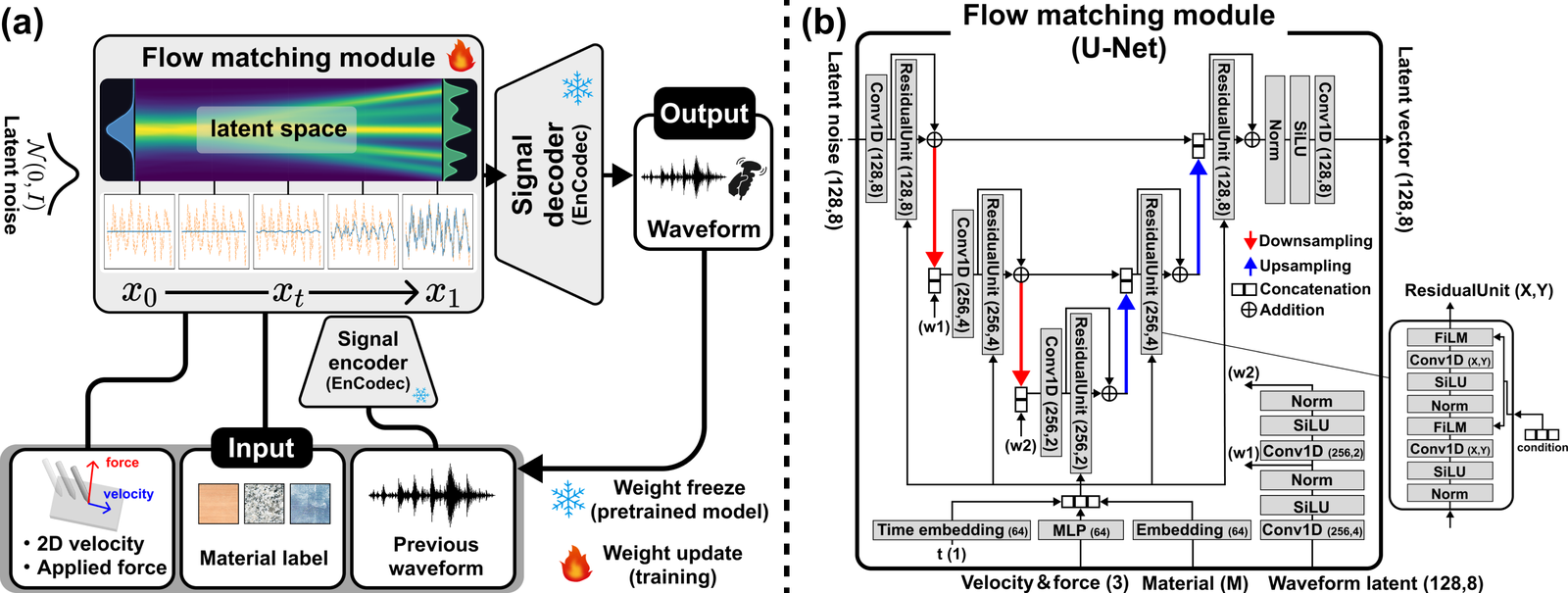
Architecture of the proposed model. (a) The model comprises a Signal Encoder-Decoder (EnCodec) and a Flow Matching module with a U-Net backbone. (b) Material labels and interaction parameters are injected via FiLM conditioning at every level of the U-Net.

At each rendering step, HaptoFlow takes a material label, interaction parameters (2D stylus velocity and applied force), and the waveform generated at the previous timestep, and outputs the vibrotactile waveform for the current timestep.

Flow Matching module

A U-Net backbone (two levels, 128 and 256 channels) estimates a conditional vector field in a latent space that transports a Gaussian noise sample toward the target waveform distribution, trained with the Conditional Flow Matching loss. Because the model learns the conditional distribution rather than a point estimate, it avoids the averaging artifacts that deterministic regression baselines exhibit on multimodal haptic data. The conditioning inputs, a material embedding, an MLP over the interaction parameters, and a sinusoidal encoding of the Flow Matching time variable, are each projected to 64 dimensions and injected into every U-Net level via FiLM.

Signal Encoder-Decoder

A pre-trained, frozen EnCodec (24 kHz sampling rate, 6 kHz bandwidth) compresses haptic waveforms into a compact continuous latent representation, reducing both training cost and inference latency. Operating in this latent space lets the ODE solver run for a single step at inference.

Training data

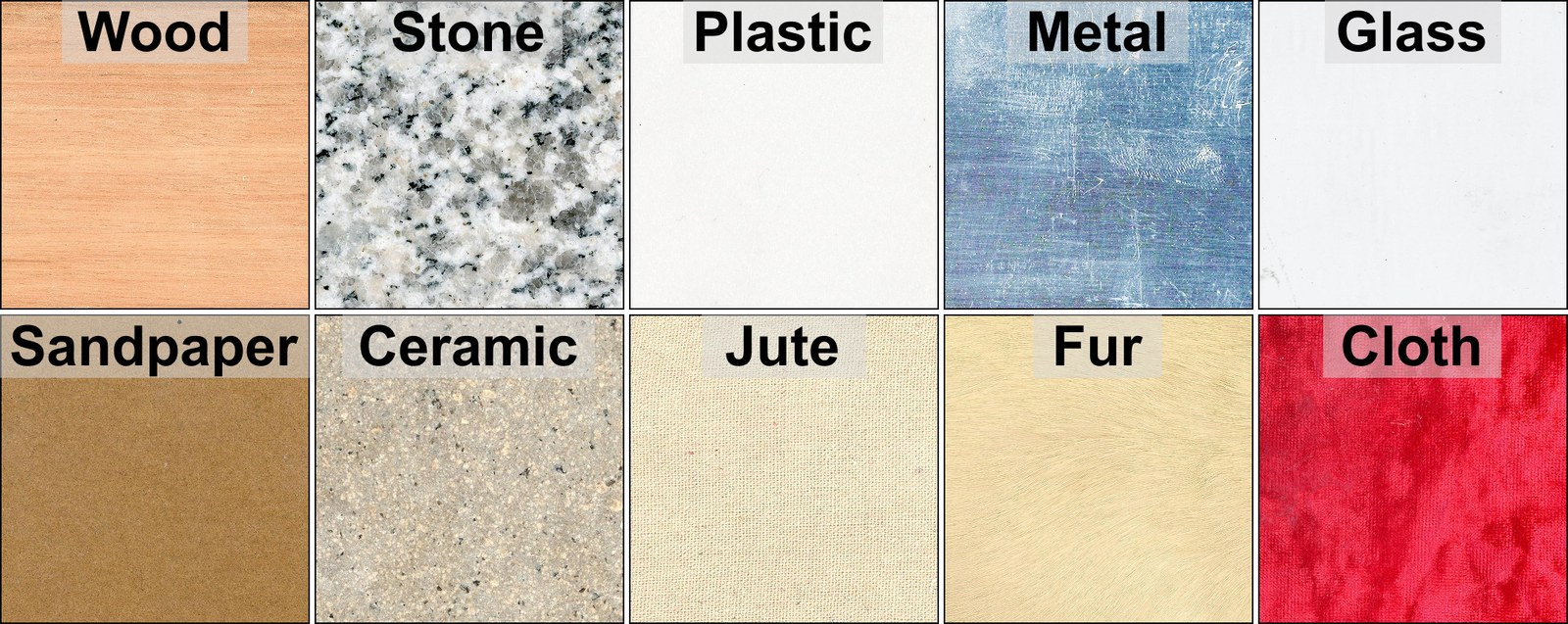
The model is trained on the Cluster Haptic Texture Dataset, which records vibrotactile waveforms and the corresponding interaction parameters for 118 materials across 10 categories. One representative material per category was selected to span distinct tactile characteristics. Three-axis accelerometer data are reduced to a single axis with DFT321, downsampled to 2 kHz, segmented into 100 ms frames with a sliding window, and normalized to the range [−1, 1].
Materials used for training and evaluation
Materials used for training and evaluation.

VR System

Overview of the VR haptic system
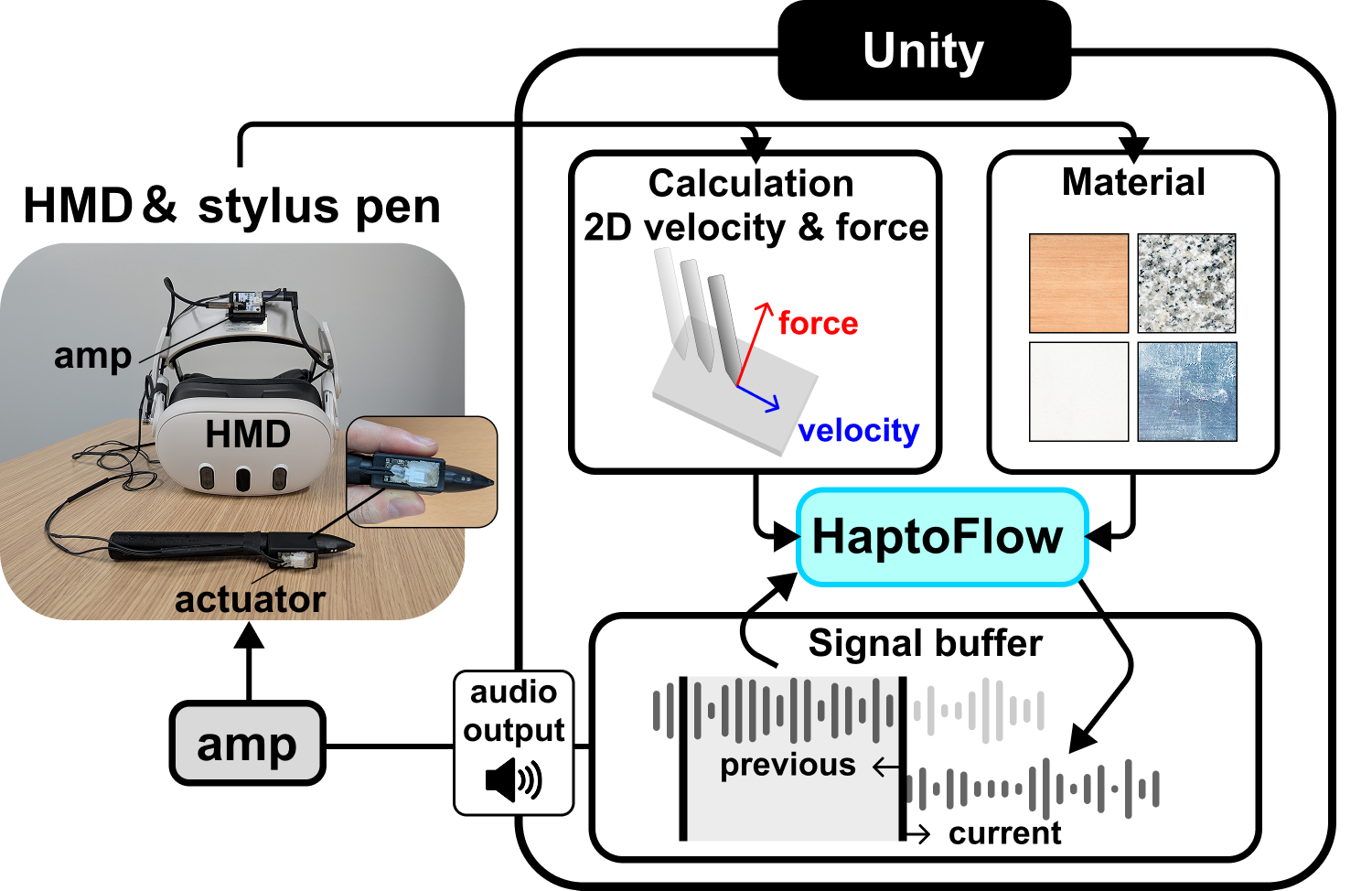
Overview of the VR haptic system. At each rendering step, HaptoFlow receives stylus velocity, contact force, a material label, and the previously generated waveform to produce real-time vibrotactile feedback via an actuator-equipped stylus.
  • HMDMeta Quest 3 (72 Hz)
  • StylusMX Ink (Logicool), 3D-tracked via Meta Quest 3
  • ActuatorHaptic Reactor (Foster Electric)
  • AmplifierPAM8012 (Diodes Incorporated)

When the stylus contacts a virtual object, the 3D stylus velocity is projected onto the tangent plane of the contact surface to obtain the 2D velocity, and the applied force is approximated with a spring model from the penetration depth. The generated 100 ms waveform is buffered and routed to the actuator through Unity's audio output system.

Technical Evaluation

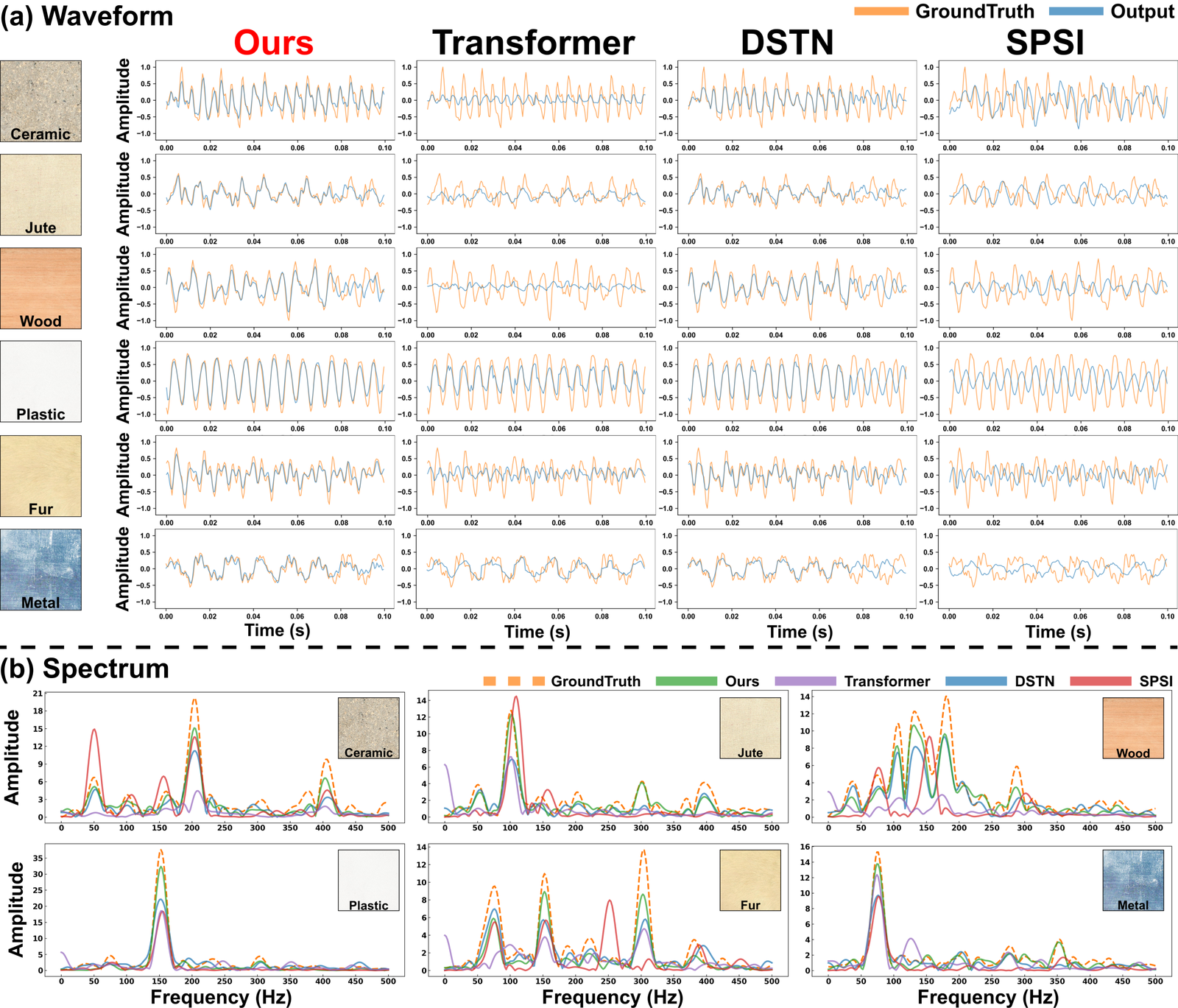
H1: The proposed Flow Matching-based model achieves (a) higher waveform reproduction accuracy (GFC, RMSE) and (b) lower inference latency than the baseline methods trained with deterministic reconstruction losses. → Supported

Waveform reproduction accuracy and inference latency of each vibrotactile generative model. Mean and standard deviation over five runs with different random seeds.
ModelGFC ↑RMSE ↓Latency (ms) ↓
HaptoFlow (Ours)0.96 ± 0.040.22 ± 0.335.2 ± 1.0
Transformer0.74 ± 0.170.39 ± 0.4113.4 ± 3.4
DSTN0.94 ± 0.050.30 ± 0.3611.9 ± 2.8
SPSI0.73 ± 0.150.49 ± 0.446.2 ± 1.8
Ground truth and generated waveforms for each model
Ground truth and output waveforms of each model for six representative samples, shown as (a) raw time-domain signals and (b) frequency spectra zoomed into the 0–500 Hz range relevant to vibrotactile perception.

User Study 1 — Visual-Haptic Latency Perception

H2: The total end-to-end system latency, including the inference time of the proposed model, falls below the human perceptual threshold for visual-haptic delay when using a VR HMD with a stylus pen. → Supported

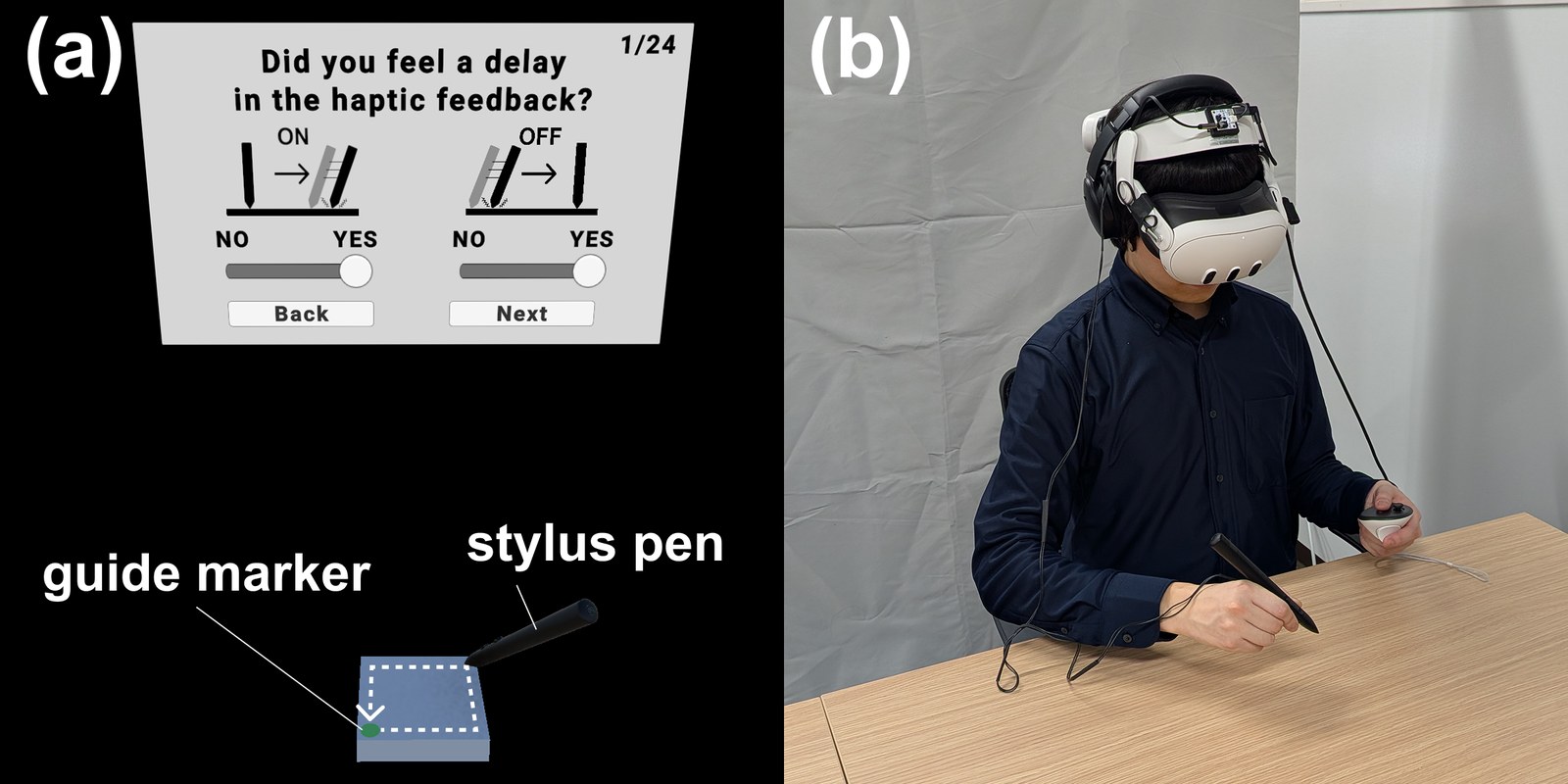
Twenty-four participants traced a virtual object with the stylus and reported whether they perceived a delay between the pen motion and the onset (Turn-On) or cessation (Turn-Off) of haptic feedback, across 11 artificially introduced latency levels from 50 to 250 ms in 20 ms steps.

Experimental setup of the latency perception study
Experimental situation. (a) VR scene viewed through the HMD, with a virtual object and questionnaire form on a dark background. (b) A participant during the experiment.
Latency perception results
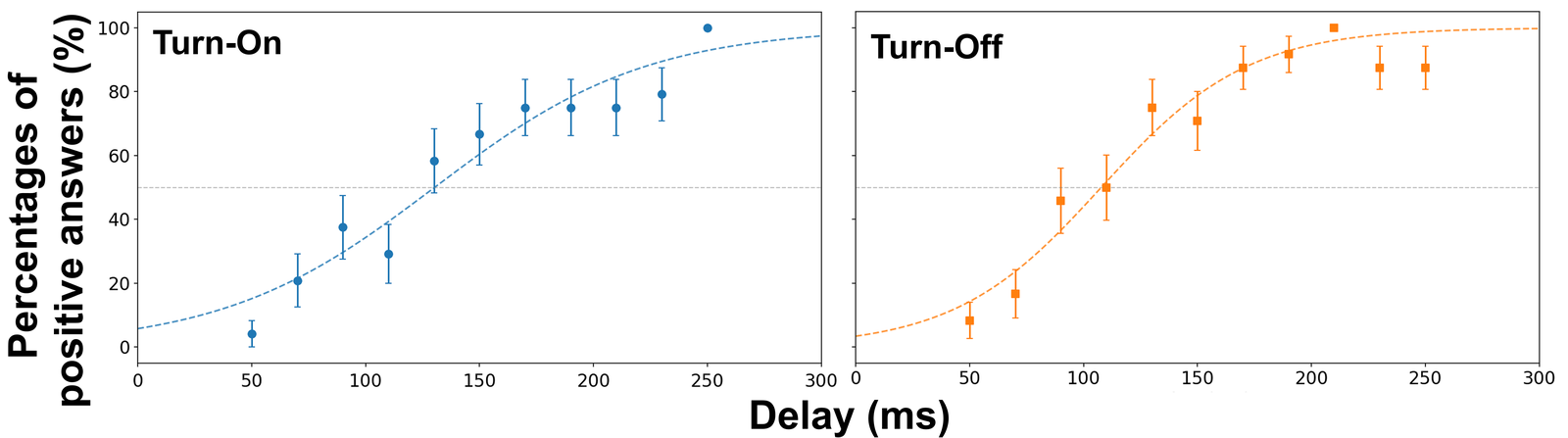
Percentages of positive answers for latency perception under the Turn-On and Turn-Off conditions. Points are means, error bars the standard error, and the dashed curves the fitted psychometric functions.

Taking the 50 % crossing point of the fitted sigmoid gives perceptual delay thresholds of 130.3 ms (Turn-On) and 107.7 ms (Turn-Off) — both far above our system's ~22 ms end-to-end latency.

User Study 2 — Perceptual Similarity to Real Objects

H3: Haptic stimuli generated by the proposed model receive higher perceptual similarity ratings to real objects than those generated by baseline methods. → Partially supported

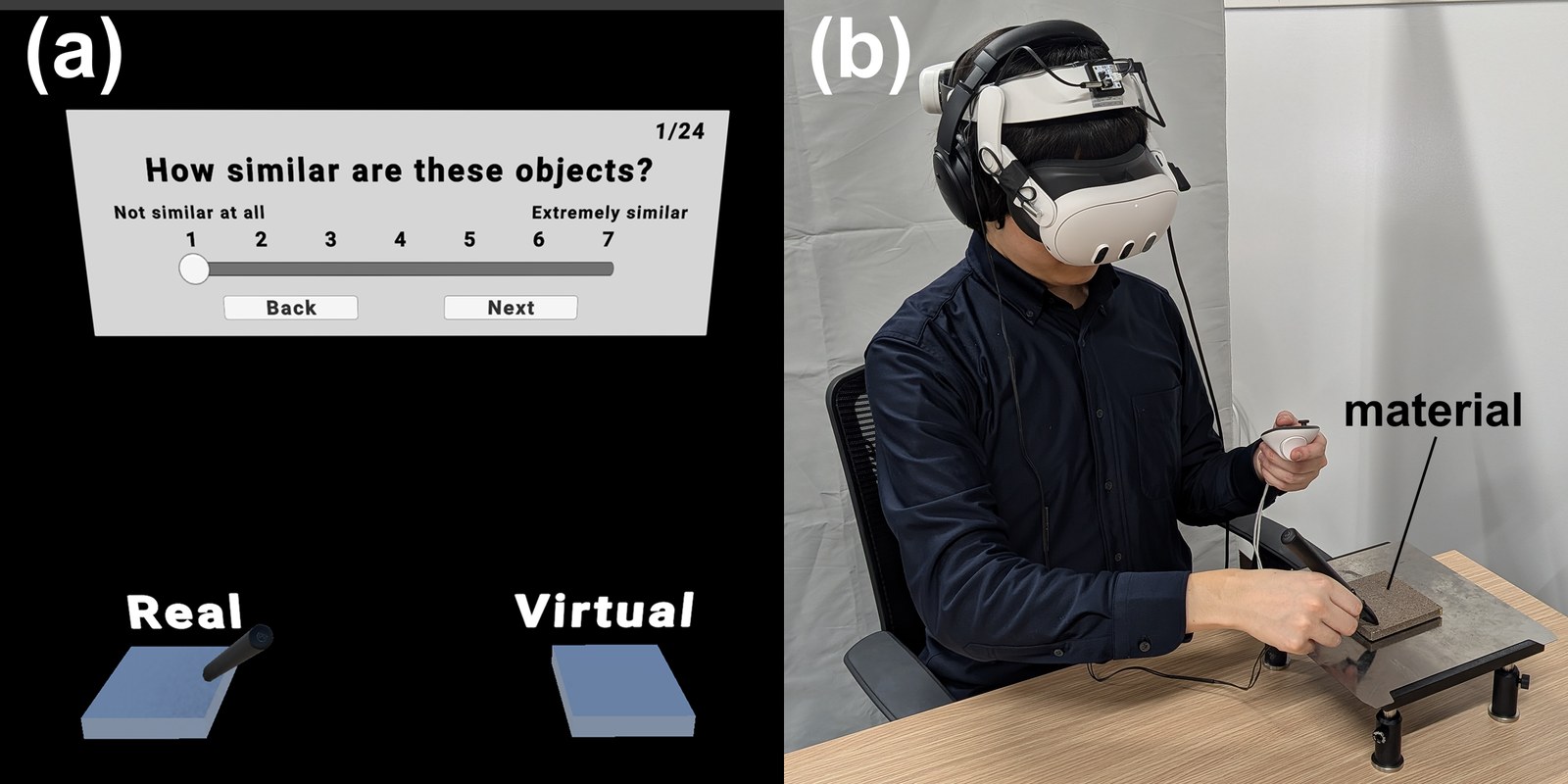
The same 24 participants alternately traced a real object and its virtual counterpart with the stylus and rated the similarity of the haptic sensation on a 7-point Likert scale, for 6 materials × 4 methods. The end-to-end system latency was equalized across methods so that waveform quality was the only variable under evaluation, and the real objects were kept out of view to avoid visual bias.

Experimental setup of the perceptual similarity study
Experimental situation. (a) VR scene showing two visually identical objects (real and virtual) and a similarity rating form. (b) A participant stroking a physical material while wearing the HMD, without seeing its appearance.
Perceptual similarity ratings
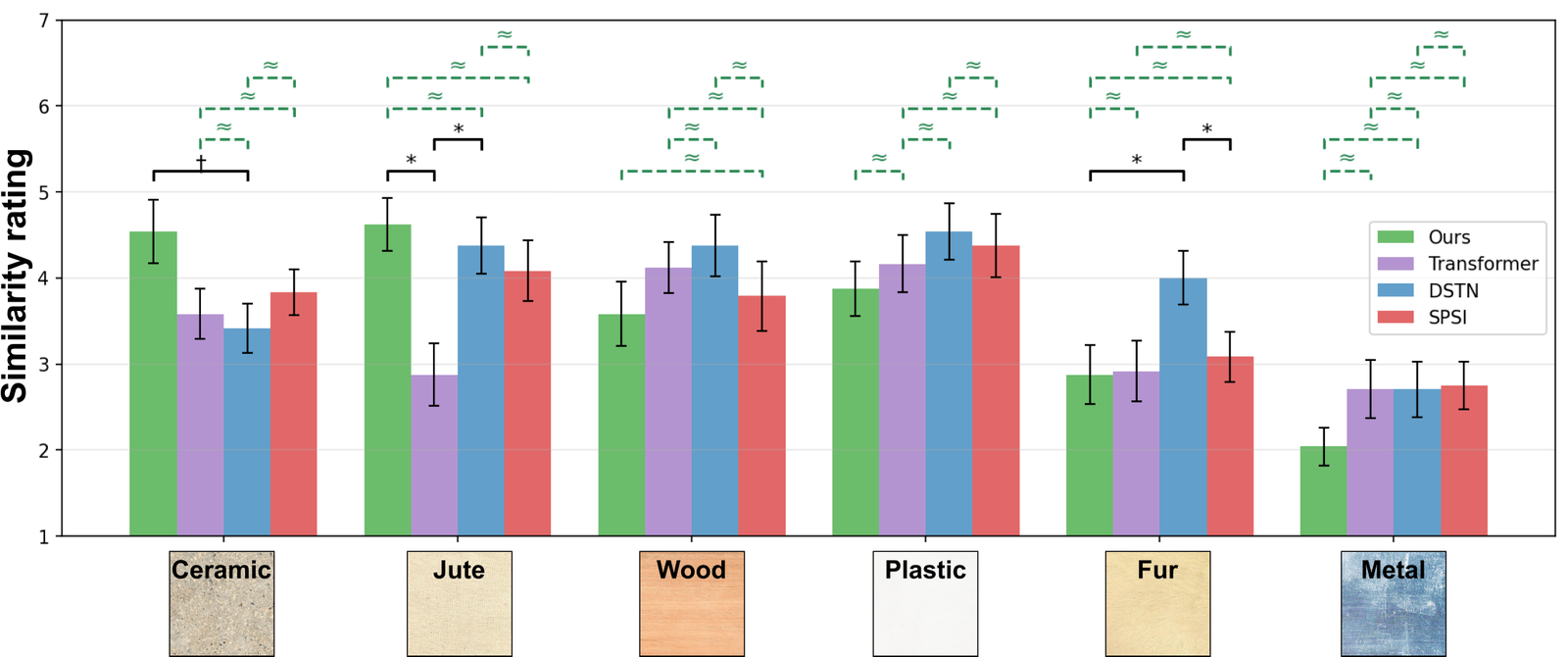
Perceptual similarity ratings on a 7-point Likert scale for each material and method. Bars are means, error bars the standard error. Brackets indicate pairwise statistical comparisons: † a trend toward significance (p < 0.1), * a significant difference (p < 0.05), and green ≈ statistical equivalence (p < 0.05).
  • HaptoFlow was rated significantly higher than Transformer for Jute (p = 0.013) and showed a marginal trend over DSTN for Ceramic (p = 0.075). Both are hard, high-roughness materials whose vibrotactile signals have prominent spectral peaks that HaptoFlow reproduces most faithfully.
  • HaptoFlow was rated significantly lower than DSTN for Fur (p = 0.047), although all methods scored uniformly low (approximately 2–3): the tactile sensation of Fur is dominated by compliance cues that vibrotactile feedback alone cannot convey.
  • For every material except Ceramic, TOST confirmed statistical equivalence with one or more baselines, suggesting that the waveform accuracy differences among methods do not always exceed human perceptual thresholds.

The gap between high signal-level accuracy and moderate perceptual ratings points to limits in training-data diversity and actuator bandwidth rather than in the generative framework itself.

Applications

Application scenarios
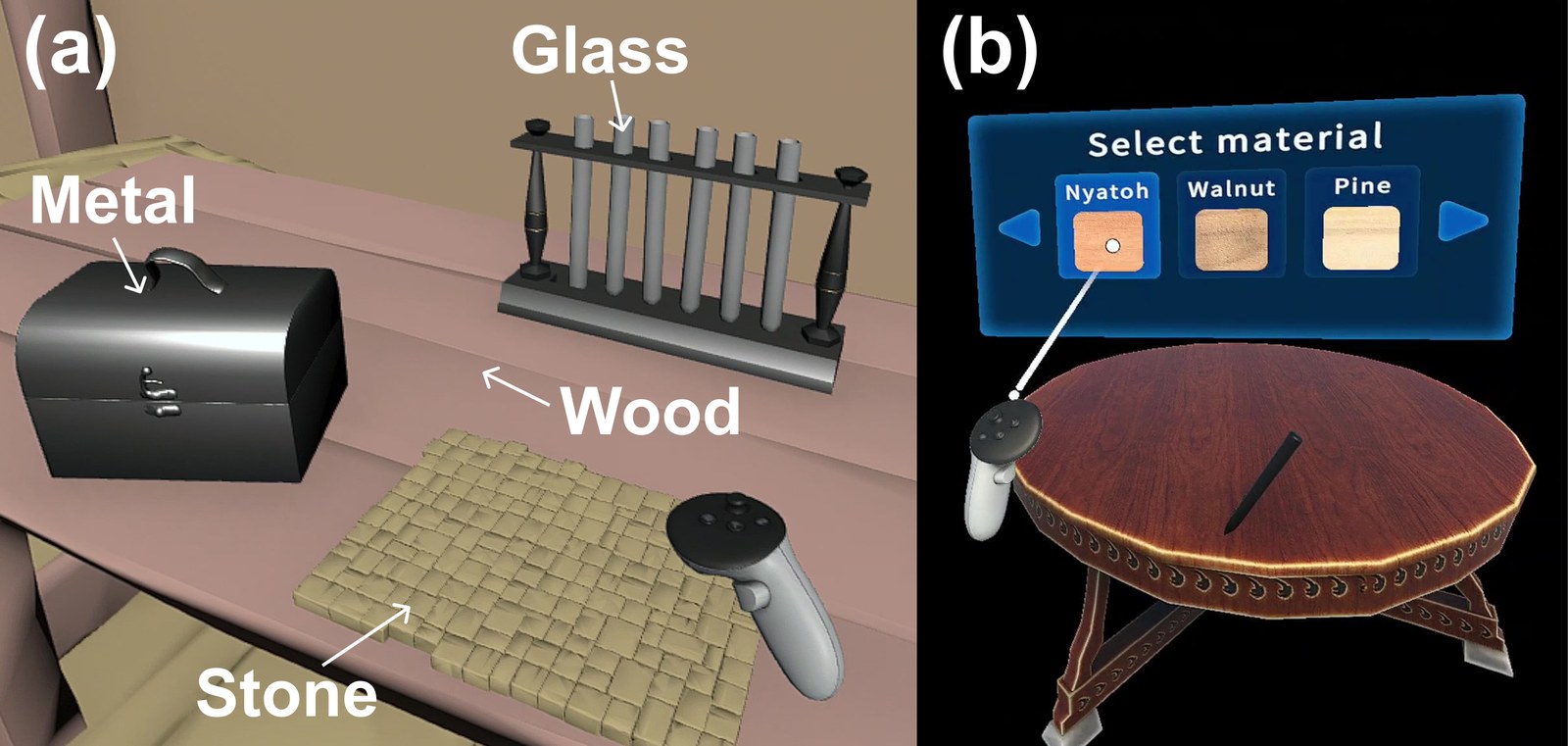
Application scenarios of the VR system integrated with the proposed model. (a) Scalable haptic authoring: material labels assigned to virtual objects drive on-the-fly haptic generation. (b) Surface texture design support: designers evaluate the tactile feel of different materials in VR without physical prototyping.

Scalable haptic authoring for VR

Assigning a material label to each virtual object and streaming interaction parameters to the model yields contextually appropriate waveforms on the fly, with no per-material manual authoring. The approach is not tied to the stylus used here: amplitude-modulation-based actuation makes it compatible with controllers such as the Meta Quest Touch Plus.

Support for surface texture design

Designers can iteratively query the model with target material labels and feel the resulting texture in real time, evaluating a product surface's tactile feel during the design process itself and reducing the need for costly physical prototyping.

BibTeX

@misc{eguchi2026haptoflowhighfidelityrealtimevibrotactile,
      title={HaptoFlow: High-Fidelity Real-Time Vibrotactile Generation via Flow Matching for Virtual Reality},
      author={Michikuni Eguchi and Yuichi Hiroi and Takefumi Hiraki},
      year={2026},
      eprint={2608.01974},
      archivePrefix={arXiv},
      primaryClass={cs.HC},
      url={https://arxiv.org/abs/2608.01974},
}

Acknowledgments

This study was supported by JST ACT-X Grant Number JPMJAX25C4 and JSPS KAKENHI Grant Number JP25H00722, Japan.